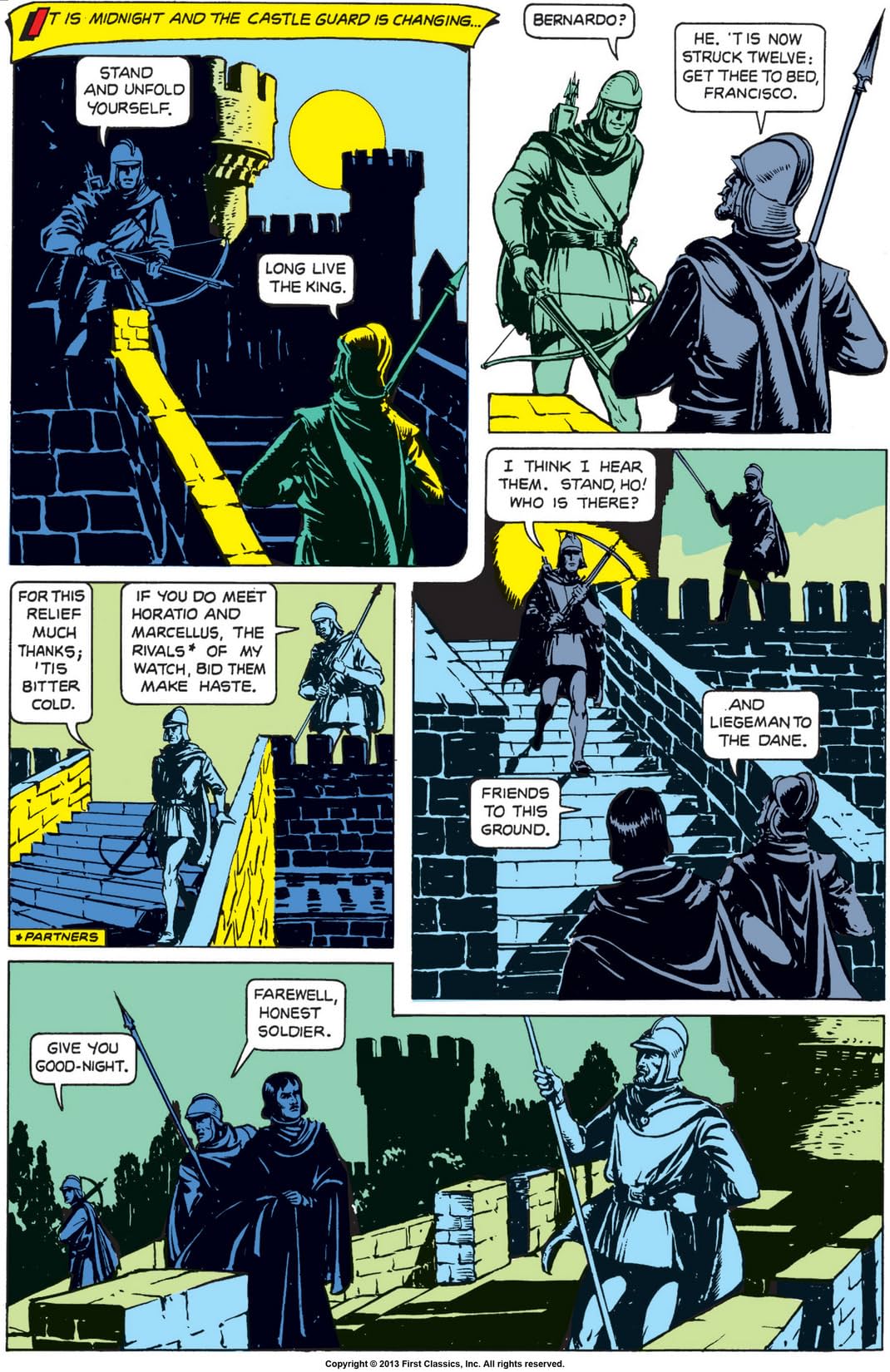
Is there anything new to say about Shakespeare? Absolutely, and Emma Smith manages to do so brilliantly... This, along with Tony Tanner's Prefaces to Shakespeare and Marjorie Garber's Shakespeare After All, is one of the best general overviews out there...Reading List 2023-006-12:
*Barth, John. The Floating Opera (reread/started)
*Havers, Richard. Blue Note: Uncompromising Expression (started)
*Jackson, Shirley. We Have Always Lived in the Castle (started/finished)
*Marvel by Design: Graphic Design Strategies of the World's Greatest Comics Company (finished)
*Smith, Emma. This Is Shakespeare (finished)
*Segar, E. C. The Complete E.C. Segar Popeye: Vol. 4 Sundays 1936-1938 (in progress)
*Shakespeare, William. Twelfth Night (Arden 3rd ed., ed. Keir Elam) (reread/in progress)
Showing posts with label Shakespeare. Show all posts
Monday, June 12, 2023
Saturday, May 13, 2017
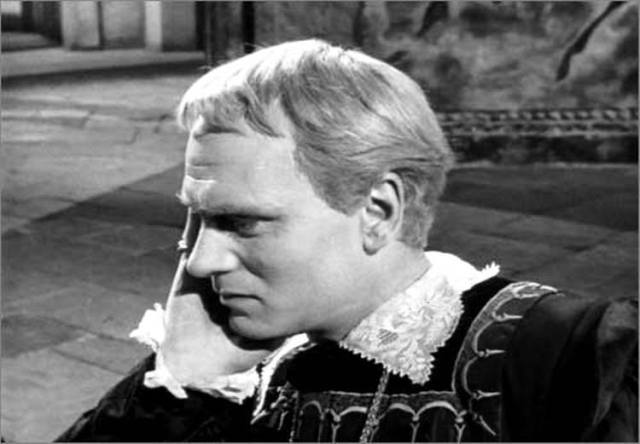
Hamlet's Double Movement

[Hamlet] is brilliantly constructed moment by moment to convey a sense at once of a hopeless stasis, of endless talk and nothing decisive happening, and of a machine hurtling helplessly towards a conclusion at once longed for and fought against.
This doubleness is felt by every viewer and reader, but it is very difficult to hold on to. For if we try to understand the play, to fathom its deepest springs, we lose the sense of its unfolding in time, while if we focus on its relentless forward motion we feel ourselves being carried not towards understanding but away from it. And all the while this double movement precisely mirrors Hamlet's own experience. (Gabriel Josipovici, Hamlet: Fold on Fold, Yale Univ. Press, 2016, p. 8)
Monday, July 25, 2016
Reading List, Week of 2016-07-24
No, I'm not an actor--but this book presents a great perspective on how to make the language come alive on stage, and is worth reading both for its close analysis of meter and phrasing and for the long section on soliloquies.
Reading List 2016-07-25:
*Peace, David. The Damned Utd (started)
*Shakespeare, William. The Merchant of Venice (Arden 2nd series, ed. John Russell Brown) (reread/started)
*Fraction, Matt, and Chip Zdarsky. Sex Criminals, Vol. 1: One Weird Trick (started/finished)
*Hinds, Andrew. Acting Shakespeare’s Language (finished)
*Martin, George R. R. A Knight of the Seven Kingdoms (finished)
Friday, March 4, 2016
On Shakespeare's Late Style
[The opening scene of Henry VIII] seemed to have the full stamp of Shakespere [sic.], in his latest manner: the same close-packed expression; the same life, and reality, and freshness; the same rapid and abrupt turnings of thought, so quick that language can hardly follow fast enough; the same impatient activity of intellect and fancy, which having once disclosed an idea cannot wait to work it orderly out; the same daring confidence in the resources of language, which plunges headlong into a sentence without knowing how it is to come forth; the same careless metre which disdains to produce its harmonious effects by the ordinary devices, yet is evidently subject to a master of harmony; the same entire freedom from book-language and commonplace; all the qualities, in short, which distinguish the magical hand which has never been successfully imitated. (J. Spedding, "Who Wrote Shakspere's Henry VIII?" in Gentleman's Magazine 178 (1850), quoted in Brian Vickers, Shakespeare as Co-Author, Oxford 2002, p. 337)
Monday, February 15, 2016
Reading List, Week of 2016-02-14
http://www.amazon.ca/Which-Shakespeare-Users-Guide-Editions/dp/0335090354
Which Shakespeare? is a somewhat useful but pretty dry comparison of various editions of Shakespeare. Very dated by this point (it came out in 1992, before any of the Arden Third Series had appeared), it is still useful for its treatment of the earlier Ardens and for its consideration of presentation and editing choices.
Reading List 2016-02-15:
*Ashbery, John. Self-Portrait in a Convex Mirror (started)
*Kushner, Rachel. The Flamethrowers (started)
*Taylor, Gary. “General Introduction,” in Stanley Wells, et al. William Shakespeare: A Textual Companion (started)
*Homes, A. M. The End of Alice (started/finished)
*Barthelme, Donald. Forty Stories (finished)
*King, Stephen. The Bazaar of Bad Dreams (finished)
*Thompson, Ann, et al. Which Shakespeare?: A User's Guide to Editions (finished)
*Geerken, Hartmut, et al. Omniverse Sun Ra [Expanded and revised 2nd ed.] (in progress)
Thursday, June 18, 2015
David Thomson on Hamlet

...Hamlet is not just a nightmare of incest or the dread of taking action, but an entire metaphor for the presentation of self. Hamlet endures and increases the more we learn about the duplicity of selfhood. It is a play about theatre and our failure to exist as more than amateurs plying ourselves. The question that hangs over it is less who wrote it than what revelations of the brain and personality are yet to come to give it greater depth. How did anyone so long ago know us so well? (David Thomson, Why Acting Matters, pp. 48-49)
Monday, September 15, 2014
Shakespeare's Writing
A wonderful description of Shakespeare's writing:
His achievement as a dramatist is inseparable from his achievement as a poet. In his verse words simply do more than in the verse of other playwrights. The language, with its kaleidoscopic show of imagery and allusion, is continually extending the range of experience gathered into the play, which becomes much more than a series of dramatized events. The poetry helps to transmit Shakespeare's sense of life and to create the imaginative world through which that sense of life is communicated. Rhythmically, the verse mimics the movements of the speaker's mind and heart. Visual and auditory elements enhance each other, as Shakespeare, writing for the bare Renaissance stage, conducts, by means of speech, a kind of 'movie-making for the mind's eye.' (MacDonald P. Jackson, Defining Shakespeare, 2003, p. 150, quoted in Will Sharpe, "Authorship and Attribution," in William Shakespeare and Others, Collaborative Plays, 2013, p. 643)
Wednesday, February 5, 2014
Reading Highlights for 2013
I realized that if I didn’t get this up soon, it’ll be 2015! So, here’s a quick rundown of what my reading highlights were for 2013.
The year started with a bang as I finished up rereading Proust’s In Search of Lost Time, which I had started back in September 2012. One of the greatest novels of all time, and one of the funniest. My main regret is that my French isn’t good enough to read it in the original. (My wife would say that reading it in translation doesn’t count, but what ya gonna do? Not read it at all?) This time I read the Enright revision of the Kilmartin/Moncrieff translation, and it worked for me, flowing beautifully and not getting in the way. Once you get started with this, you get enthralled and it’s really hard to put down. I like the way John Williams puts it:
I first read Proust back in the early ‘80s, and, not surprisingly, many things have changed about me and my reactions to the novel the second time around. One thing was that since I already had a general idea of how things developed, the major plot twist and turns didn’t amaze me like they did the first time. That’s to be expected. What I didn’t expect, though, was my sense of how well-developed Albertine is as a female character. First time through, knowing as I did that Albertine was based on in part (and was a stand-in for) Proust’s chauffeur Albert Agostinelli, I felt she lacked something as a woman, although that didn’t bother me because I understood (or thought I did) that it was really a homosexual relationship being presented. I so underestimated Proust as a novelist. This time through, I could appreciate (or I think I did) the steps Proust took to ensure that Albertine stands alone outside the hidden context, and further, that she exists on her own very female terms. I am undoubtedly not explaining this as well as could be done, but after all, this is a blog, not a term paper....as with any great work, it doesn’t take very long to acclimate to Proust’s rhythms and idiosyncrasies. This is not to say the reading experience picks up steam. A nearly extinct brand of patience is required. The pages don’t start turning any faster; I’m just more and more content to be immersed in them. (John Williams, "Reading Proust: A First-Timer Dives In")
Another aspect of the novel that surprised me upon reprise was my strong sympathy for Charlus. I was repelled by him the first time around, but now I sympathized with his plight, and I felt ashamed for Marcel the narrator when he so rudely rejects Charlus. In fact, the whole novel wrenched me up all over again, even though I had a hard time abiding Marcel’s selfish insularity and self-centeredness when it came to Albertine (and to others scattered throughout the book). The first time through, I was much more sympathetic to his jealousy and need of control.
The major publishing event of the year for me was, of course, Pynchon’s new novel Bleeding Edge. Even though I was a bit disappointed, I also know his writing well enough to know that there’s way more to it than what you get on first reading. I’m tired of the clever-strong-likeable-female-falling-for-fascistic-asshole plot point (a strong Pynchon motif in, at least, Vineland, Inherent Vice, and Against the Day). I didn’t totally buy it that Maxine would go so far as to strip and pole dance just to find a certain computer geek at a club--I felt like it was more of an excuse for Pynchon to use the clever club name Joie de Beavre (which, granted, is pretty damn funny). Never before have I felt that a whole episode of Pynchon’s novels existed solely to be a set-up and not for other reasons as well. Here, it didn’t add anything to the plot that couldn’t have happened otherwise.
All that said, there were many, many moments of pure brilliance in the novel, from Pynchon’s understated depiction of New York City post-911, to his character Speedwell Conkling, a client with a nose for trouble. It was wonderful to return to Pynchon’s world of words. As Jonathan Lethem puts it in his excellent review: “Our reward for surrendering expectations that a novel should gather in clarity, rather than disperse into molecules, isn’t anomie but delight.”
Besides Lethem’s there are two other strong reviews of Bleeding Edge worth seeking out: Michael Chabon’s and Joshua Cohen’s. All three are gathered in one place at the Bleeding Edge wiki. I’m sure I missed way more than I got from a first reading. I’ll get back to it again after revisiting Against the Day.

I really enjoyed Volume 2 of critic and editor Steven Moore’s ongoing history of the novel, The Novel: An Alternative History, 1600-1800. Volume 1 (Beginnings to 1600) was a revelation. Based on his interpretation of the Webster definition of the novel as “a book-length work of fiction,” Moore widely expands the scope and breadth of most literary histories, dealing with works appearing centuries before where most literary histories designate as the start of the novel (say, Tale of Genji or Don Quixote or Pamela). The introduction on its own is well worth reading.
Volume 2 (1600-1800) continues the revelations, although Moore does admit he had to scale back in order to include more of what he’s most interested in, the experimental and the innovative (not surprising given his groundbreaking work on Gaddis). As it is, he cranks through pithy, entertaining commentary on hundreds of novels from all over the world. This is the kind of book that requires having an ongoing list nearby to keep track of everything I must read. Here’s my list of novels to investigate from Vol. 2 alone:
Grimmelhausen, Hans Jakob Christoph von. Simplicissimus (tr. Mike Mitchell) Dedalus, 1999
Richter, Jean Paul.
1. Invisible Lodge (tr. Charles Brooks, 1883)
2. Hesperus (tr. Charles Brooks, 1865)
3. Flower, Fruit, and Thorn Pieces, etc. (tr. Brooks 1877)
4. Titan (tr. Brooks, 1862)
Sorel, Charles. Critical edition of The Comical History of Francion (1655). Tr. John Wright. Chicago
Spectrum, 2005
Challe, Robert. Love and Laughter in the Reign of Louis XIV (The Illustrious French Lovers), tr.
Preston, Book Guild, 2008
Marivaux, Pierre. Pharsamond, tr. Lockman (1743)
Marivaux, Pierre. The Life of Marianne, tr. Lockman? (1750)
Diderot. Jacques the Fatalist and His Master. Tr. Coward, Oxford 1999
Maistre, Xavier de. Voyage around My Room (tr. Sartarelli, New Directions 1994)
Lu Tiancheng. Embroidered Couch. tr. Lenny Hu, 2001
Tung Yueh. Tower of Myriad Mirrors. tr. Shuen-fu Lin & Larry Schulz. Asian Hum. Press. 1978. 2nd
ed: U Mich., 2000. Prefer 1st ed. (it is more complete)
Kim Manjung. Kuunmong: The Cloud Dream of the Nine. Tr. Rutt & Kim Chong-un, in Virtuous
Women: Three Masterpieces of Traditional Korean Fiction. UNESCO, 1974.
Tamenaga Shunsui. Love’s Calendar. Tr. Woodhull. In “Romantic Edo fiction” (PhD diss., Stanford,
1978)
Swift, Jonathan. Tale of a Tub. ed. Walsh. Cambridge, 2010
History of Charlotte Summers. London: Charles Corbett, 1749 [anonymous]
Beckford, William. Vathek (tr. Henley, Marzials)
Adventures of Jonathan Corncob, Loyal American Refugee [anonymous] Godine, 1976
Brown, Charles Brockden. Edgar Huntly, or, Memoirs of a Sleepwalker (Library of America)
The highlights of this volume were many, and I’ll mention just two: his lengthy essay on Don Quixote (which also appeared as a separate article here), and the masterful essay on Tristram Shandy--what a way to wrap up the 18th century!
You can find an excellent interview with Steven Moore on his project here.
Let’s see… what were the other high reading points for me in 2013? I decided to reread all of the Ian Fleming James Bond novels. That was great fun. My favorites were Moonraker and Diamonds Are Forever.
I finally got around to reading the magnificent Recording the Beatles, by Brian Kehew and Kevin Ryan, a masterwork of recording detail and audio gadgetry that’s the best description ever of the technical (and magical) work of George Martin and the team at EMI. It’s the ideal companion to Lewisohn’s Complete Beatles Recording Sessions, with more than you’d ever want to know about reverb, flanging, ADT, and multitrack recording.
I reread Shakespeare’s Tempest in two different editions (Arden second series and Arden third), then watched (and thoroughly enjoyed) the Julie Taymore film with Helen Mirren as Prospero (er, Prospera).
Finally, another novel that really resonated with me was Peter Heller’s The Dog Stars. A poetically brilliant rendering of a post-apocalyptic world and a meditation on the purpose of life, Dog Stars was just beautifully written. I’d like to close with a passage at length. The main character, Hig, is flying his plane over the mountains, thinking about the past:
Winter Park and the Fraser Valley revealing itself on the other side as we go over. Scores of ski trails tender green against the rust of the dead forests. We used to ski there. The last time Melissa and I split up for a run and I rode next to a big man who said he was here for winter break with a church group from Nebraska. Nondenominational.
We just follow the Bible word for word he said. Word for word you can’t go wrong. Shook his head nice smile. I’d be crazy to disbelieve him.
I thought of stones in a river, rock hopping. One rock to the next, nothing to think about. Word for word. Just follow them, man. Breadcrumbs right to God. Sitting the chair next to him, our skis dangling over sixty feet of air, I thought Maybe there is a different translation for meek. Maybe it’s not the meek who inherit, maybe it is the simple. Not will inherit the earth, they already own it.
I told him I always got stuck at the Begats. I said I had just read Lamentations though and it seemed like Mad Max. I mean women eating their babies, everybody dying.He didn’t laugh.He said, I try to stay on the Right Side of the Bible. Left side was written by Jews. Some things to pay attention to, I guess, but if I were you I’d start with John.We should all have paid more attention to the Left Side I am thinking now. The Wrong Side, the Side Where Shit Goes Really Really Wrong. (p. 157)
Sunday, October 20, 2013
Reading about music
Some thoughts on why I enjoy reading about music, revised from an old email:
There’s this great early take of “It Won’t Be Long,” take 7. It unfortunately only exists as a monitor mix, so the sound is a bit distant, but compelling nonetheless. It chugs along pretty much the same as the released version, until it gets to this magical point right after the first verse and before the chorus: right before John sings “It won’t be long, yeah,” the whole band comes to a halt and there’s this one great beat of silence, a stop-time moment that changes the whole tenor of the song. They repeat this before every chorus in the song. It’s one of those moments that, once you hear it, makes you never hear the released version the same again. It’s not better than the released version (hours of listening to Beatle outtakes and alternates proves nothing if not that they almost always made the right choices on what to keep in and what to discard), but it’s a knockout version in its own right. It’s powerful, it’s dynamic, and it reaffirms for me that “It Won’t Be Long” is one of the Beatles’ absolute greatest early rockers.
In reading Richie Unterberger’s book The Unreleased Beatles, I was interested to get to his take on this version. Here’s what he says: it “isn’t much different from the With the Beatles track at all. The main difference is how the fellows periodically come to dead pauses between the verse and chorus instead of playing all the way through” (p. 66). Huh. Is that all he could find to say about it? How could he hear something so totally different from what I hear? And how could he not be excited about the difference?
While I disagree with Unterberger from time to time on his assessment of many of the unreleased tracks, he does pay attention to detail. What bothers me most is that his prose is pedestrian and lackluster, and he tends to second-guess the Beatles a lot (saying things like “this probably means they meant to...”).
But the point I’m trying to make is that reading what he wrote about “It Won’t Be Long” helped me articulate what I think about it. I thought it all along, from the first time I heard it, but seeing a counter-opinion in words helped me put into words what I thought. Potentially, those words could help others articulate their own thoughts—and thus you get discourse, communication, exchange of ideas—a positive thing. And, thinking about the words made me think more about the music...and sent me back to listen again.
These points make up a large part of why I read about music.
I spend a lot of time rereading Shakespeare. I’m reading different editions and really getting into the variations between the quarto and folio texts, and I enjoy getting mired in the scholarly discourse over the tiniest bibliographical details. I’m also slowly working through the ArkAngel series of BBC recordings of every play on CD; reading the plays along with the voices is tons of fun. I find this work endlessly fascinating. I came across a nice quote when reading Ron Rosenbaum’s excellent book The Shakespeare Wars. In it, he sums up many of the recent controversies and issues in the Shakespeare community (did he revise his plays or not? is the “Hand D” sample his actual handwriting? is it better to read the plays in their original spelling? etc.). At one point in the first chapter, he’s addressing the issue of why Shakespeare is so revered—what is the value of his work, and what’s made it so enduring? He quotes scholar Christopher Ricks: “the test of value in a work of art is ‘whether it continues to repay attention’ “ (p. 21). Note that he makes a point of saying not just that it repays attention, but that it continues to repay attention.
Two things struck me here, not huge flashes of insight, surely, but compelling to me anyway: Shakespeare surely does that, continues to repay attention, and so, too, do the Beatles, and so, too, does Sun Ra. These are lifelong endeavors; these bodies of work will continue to reward and re-reward us however close and detailed the attention paid to them is. I have certainly found that to be true with the Beatles, and I’m finding it to be true the more I delve into the music of Ra.
Subscribe to:
Posts (Atom)